

“`
Scroll through almost any list of live projects in Kenya and you’ll spot the same status sitting next to several of them: “county approval.” It’s the stage where the most time quietly disappears. The building approval process in Kenya isn’t one submission and a wait, it’s a sequence of documentation stages that either move smoothly because they were prepared properly, or stall for months because they weren’t.
If you’re a developer, an institution, or a board planning a build, understanding how the building approval process in Kenya actually works, and where it typically breaks down, is worth doing before the design is finished, not after.
The Stages, in Order
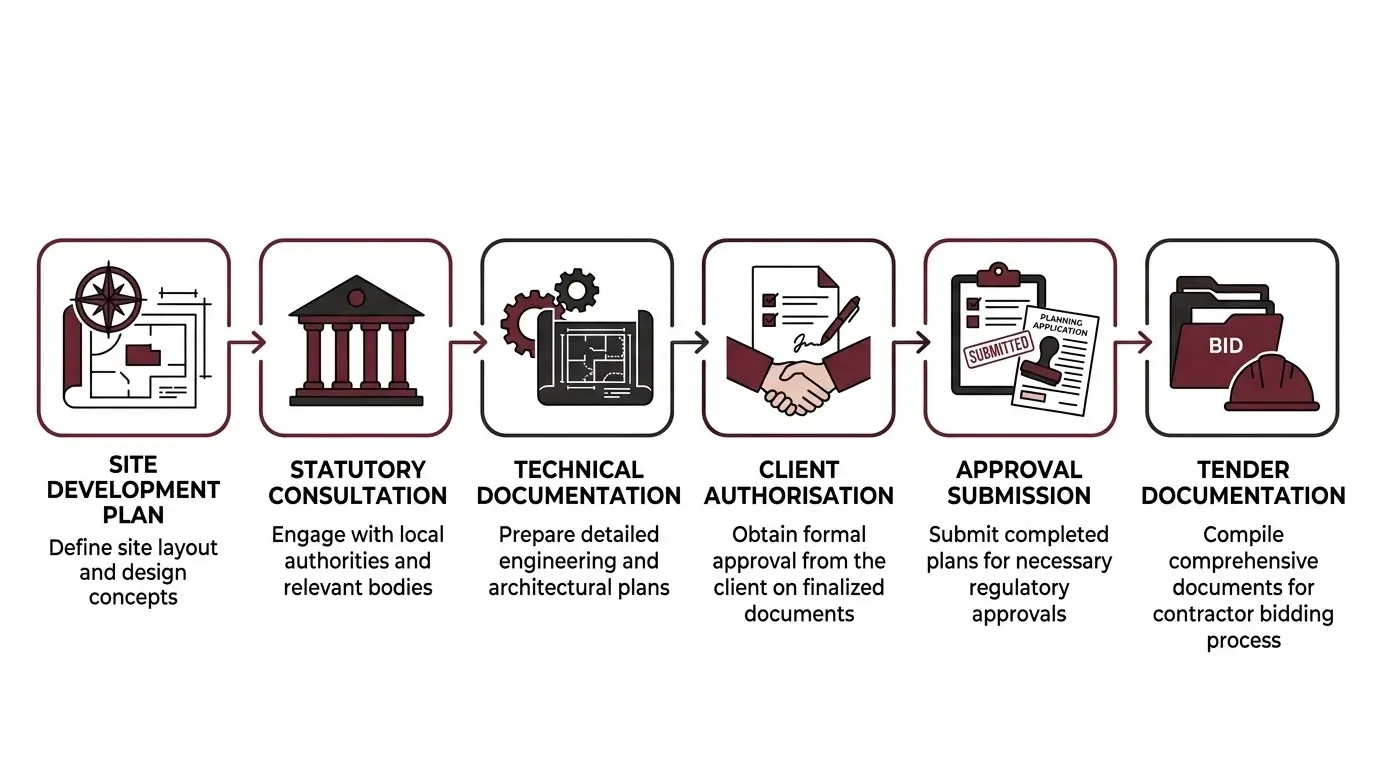
Trioscape’s own process breaks local authority approval into distinct steps rather than treating it as a single event:
| Stage | What’s submitted or reviewed |
|---|---|
| Site development plan | Submitted to the local authority early, at concept stage, if required for the project |
| Statutory consultation | Design is reviewed against local and statutory authority requirements during design development |
| Technical documentation | Coordinated with consultants and prepared for formal submission |
| Client authorisation | Client formally authorises submission of documents for approval |
| Approval submission | Documents go to the relevant local authority for review |
| Tender documentation | Runs alongside or after approval, so a contractor can be appointed once the design is cleared |
Why Some Projects Sail Through and Others Don’t
On Trioscape’s own project list, several developments are currently sitting at “county approval” or “scheme design” stage, multi-building school and institutional projects with classrooms, dormitories, dining halls and chapels all on one site. That’s normal for complex developments. What separates a smooth approval from a stalled one usually comes down to how well the documentation was coordinated before submission, not the county office itself.
| Factor | Prepared submission | Rushed submission |
|---|---|---|
| Consultant coordination | Structural, M&E and architectural drawings match before submission | Discrepancies found after submission, causing re-review |
| Site development plan | Filed early, ahead of detailed design | Filed late or skipped, causing conflicts with later drawings |
| Client sign-off | Confirmed before submission | Sought after submission, adding a delay loop |
| Typical outcome | Fewer review cycles | Multiple rounds of queries and resubmission |
What Developers Can Do to Avoid Delays
- Submit the site development plan early, before detailed design locks in decisions that might conflict with it.
- Coordinate consultants before submission, not after a query comes back from the county office.
- Get client and board sign-off ahead of time, so submission isn’t held up waiting for an internal decision.
- Treat tender documentation as a parallel track, so a contractor can be appointed as soon as approval clears, rather than starting that process from scratch afterwards.
The Bottom Line
The building approval process in Kenya moves at the pace of the documentation behind it. Projects that treat site development plans, statutory consultation and tender preparation as sequenced, coordinated stages tend to clear approval faster than those that submit everything at once and hope for the best.
Navigating the Building Approval Process in Kenya?
Talk to Trioscape about getting your site development plan and documentation coordinated before submission, not after.
Read more about Trioscape’s design and approval process, or see how construction project management in Kenya continues once approval is granted.
FAQs
How long does the building approval process take in Kenya?
It varies by county and project complexity. Multi-building or institutional developments generally take longer than a single standalone structure, since there’s more documentation to review.
What’s the difference between a site development plan and a building permit?
A site development plan sets out how the site as a whole will be used and is typically submitted earlier, at concept stage. A building permit is approval for the specific construction documentation of a building and comes later, closer to the tender stage.
Why do projects get stuck at county approval for months?
Usually incomplete documentation, drawings that don’t match the site development plan already on file, or coordination gaps between the architect, structural engineer and other consultants.
Can construction start before full approval is granted?
Starting works ahead of full approval carries real risk, including stop orders and rework if the approved design differs from what’s been built. It’s safer to treat approval as a gate, not a formality to catch up on later.
“`