

“`
A parish hall and a private office block are not the same design problem, even if they’re the same square footage. Church and institutional architects in Kenya are dealing with congregational seating, phased construction as funds come in, boards and dioceses instead of a single decision-maker, and buildings that are expected to still be in use in fifty years, not fifteen. Get the wrong firm for that brief, and you find out at the worst possible point: mid-construction, or mid-approval.
This post looks at what actually separates institutional and religious building work from standard commercial or residential design, and what to check before appointing church and institutional architects in Kenya for your project.
What Makes Institutional Projects Different
A handful of things come up again and again on institutional and faith-based work that rarely apply to a standalone house or shop:
- Multiple decision-makers. A diocese, a board of trustees, or a congregation’s leadership often needs to review and approve design decisions, not just one client.
- Phased funding. Many institutions build in stages as donations or budgets allow, so the design needs to work at every phase, not only once it’s fully built out.
- Mixed building types on one site. A school might need classrooms, dormitories, a chapel, a kitchen and dining hall, and sports facilities, each with different technical requirements.
- Long design life. Churches, university buildings and hospitals are built to serve for decades, so materials and layout decisions carry more weight than a shorter-life commercial fit-out.
Trioscape’s Institutional Track Record
This is the segment Trioscape Space Planning has worked in since 1994. Recent and ongoing projects include the Mt. Carmel Girls’ Administration & Tuition Block in Kajiado County for the Congregation of Carmelite Registered Trustees, Tassia Catholic Primary School in Embakasi for the Archdiocese of Nairobi, the proposed A.C.K. St. James Junior School in Kiambu County for the Anglican Church of Kenya, and St. Monica Primary & Junior School for the Orsoline Sisters of the Immaculate Virgin Mary. On the government and academic side, the firm has worked on a proposed administration block for the Kenya Judicial Academy and multiple projects for Tangaza University College, including a five-storey library designed for roughly 1,300 students and 1,700 staff. Trioscape also designed the Village Shrine of Mary in Subukia, a church development built to serve over 5,000 people. See the full project portfolio for more examples.
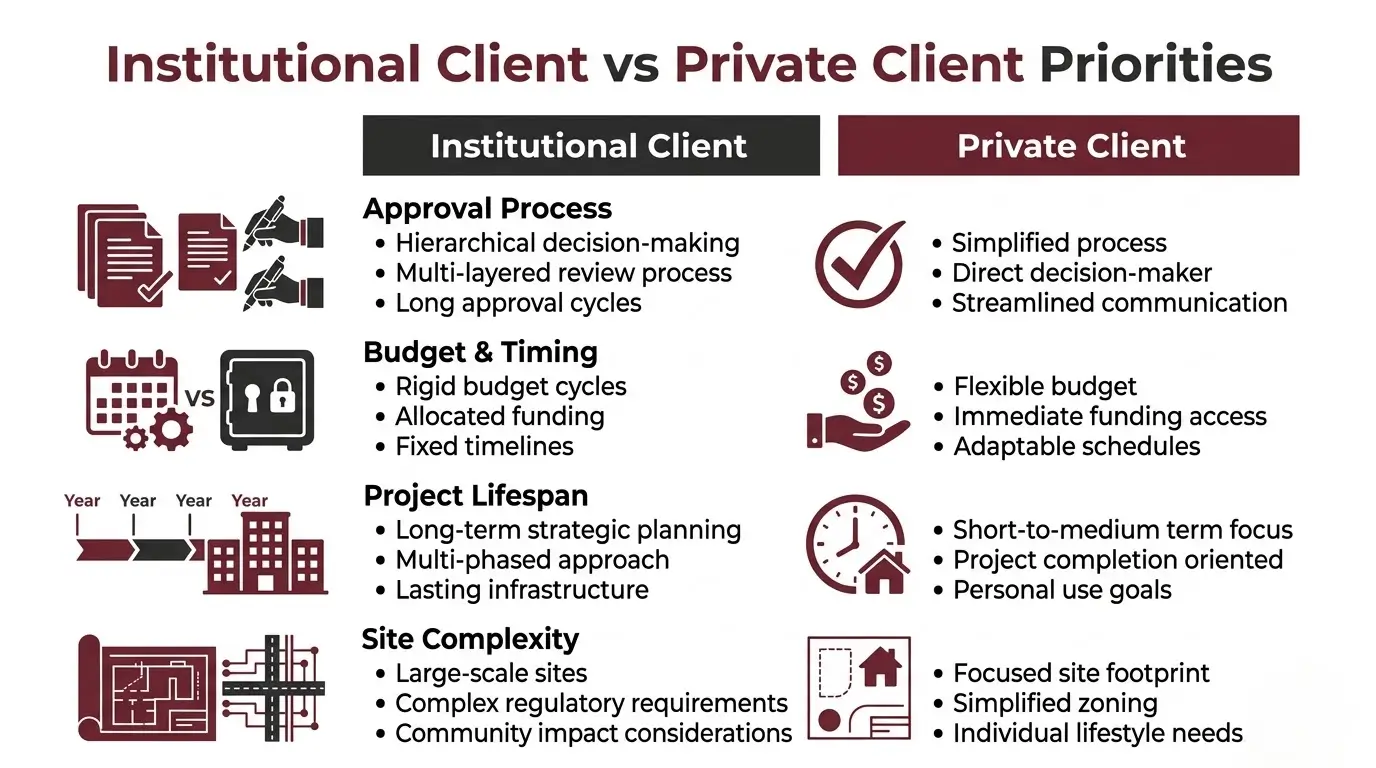
| Priority | Institutional / church client | Standard private client |
|---|---|---|
| Approval process | Design signed off by a board, diocese or trustees before submission | Usually one decision-maker |
| Budget timing | Often phased as funds are raised or released | Typically funded upfront or via one loan |
| Building lifespan | Designed for multi-decade use | Varies by project type |
| Site complexity | Often multiple building types on one masterplanned site | Usually a single structure |
What to Check Before You Commission a Firm
- Ask for examples of similar institutional work, not just any completed building. A firm strong in residential design isn’t automatically strong in dormitory layout or congregational seating.
- Ask how they handle multi-stakeholder approval. Boards and dioceses need clear presentation material, not just technical drawings.
- Ask whether they can design for phased construction if your funding will come in stages rather than all at once.
- Check their registration status. This matters even more on institutional work, where a rejected submission can affect a whole board’s timeline, not just one client.
The Bottom Line
Church and institutional architects in Kenya need to manage more stakeholders, more phases, and longer design horizons than most commercial work asks for. A track record with dioceses, school boards and government institutions is worth checking for directly, not assumed from a general portfolio.
Planning a Church, School or Institutional Building?
Talk to Trioscape about a project that needs phased delivery, multi-stakeholder approval, or a design built to last decades.
Read more about Trioscape’s architectural design process, or see how architect fees in Kenya are structured for larger, multi-phase institutional projects.
FAQs
Do church and institutional projects need a different architect than a house or office?
Not a different profession, but different experience. Congregational spaces, dormitories, laboratories and academic buildings each carry their own code and layout requirements that a firm without institutional experience may not have handled before.
Why do so many church and school projects stall at county approval?
Multi-building, phased developments (a school with classrooms, dormitories, a chapel and sports facilities, for example) have more moving parts to document and approve than a single structure, so submissions need to be sequenced carefully to avoid delays.
Can a project be phased if the full budget isn’t available yet?
Yes. Institutional clients frequently build in phases as funding becomes available. This is exactly what a master plan is for, so each phase fits into the final layout instead of constraining what comes next.
Who typically approves the design on a diocesan or institutional project?
It varies, but often a board, a diocese’s own technical committee, or a congregation’s trustees are involved alongside the client contact, which means the architect needs to present and revise designs for more than one decision-maker.
“`