

“How much do you charge?” is usually the third question a client asks, right after “can you do this?” and “how long will it take?” It’s also the hardest one to answer honestly, because architect fees in Kenya aren’t a flat number pulled from a price list. They depend on the size of the project, how complicated the site is, and how many stages of work you actually need from the architect.
That vagueness is exactly why so many building projects in Kenya go over budget before the first block is laid. People sign an architect without understanding what they’re paying for, then get surprised when a “design fee” invoice arrives for work they thought was already covered.
This post breaks down how architect fees in Kenya are typically structured, what you’re paying for at each stage, and the questions worth asking before you commit to a firm. If you’d rather skip ahead and get a figure for your own project, get in touch with Trioscape’s team.
Why There’s No Fixed Number
Architect fees in Kenya are generally calculated as a percentage of the total construction cost, not a flat rate. A small residential extension and a multi-storey institutional block don’t take the same hours, the same number of site visits, or the same level of technical coordination, so pricing them identically would be unfair to both ends.
What is consistent, at least at a well-run firm, is how the work is broken into stages, and that structure is what actually protects your budget. You can see exactly what you’re paying for at each point rather than one lump sum with no breakdown.
What You’re Actually Paying For, Stage by Stage
At Trioscape Space Planning, the architectural service is split into defined phases, each with its own share of the overall fee:
| Project stage | Share of total fee | What happens |
|---|---|---|
| Inception | 5% | Client brief, site assessment, budget and programme review |
| Concept & Viability | 15% | Initial design, space planning, cost and materials review |
| Design & Development | 20% | Detailed design, statutory consultation, construction system |
| Local Authority Approvals | 20% | Documentation, specifications, approval submissions |
| Construction Documentation & Tenders | 10% | Tender preparation, offer evaluation, contract award |
| Construction | 27% | Site supervision, contract administration, quality checks |
| Close Out | 3% | As-built drawings, handover documentation, certification |
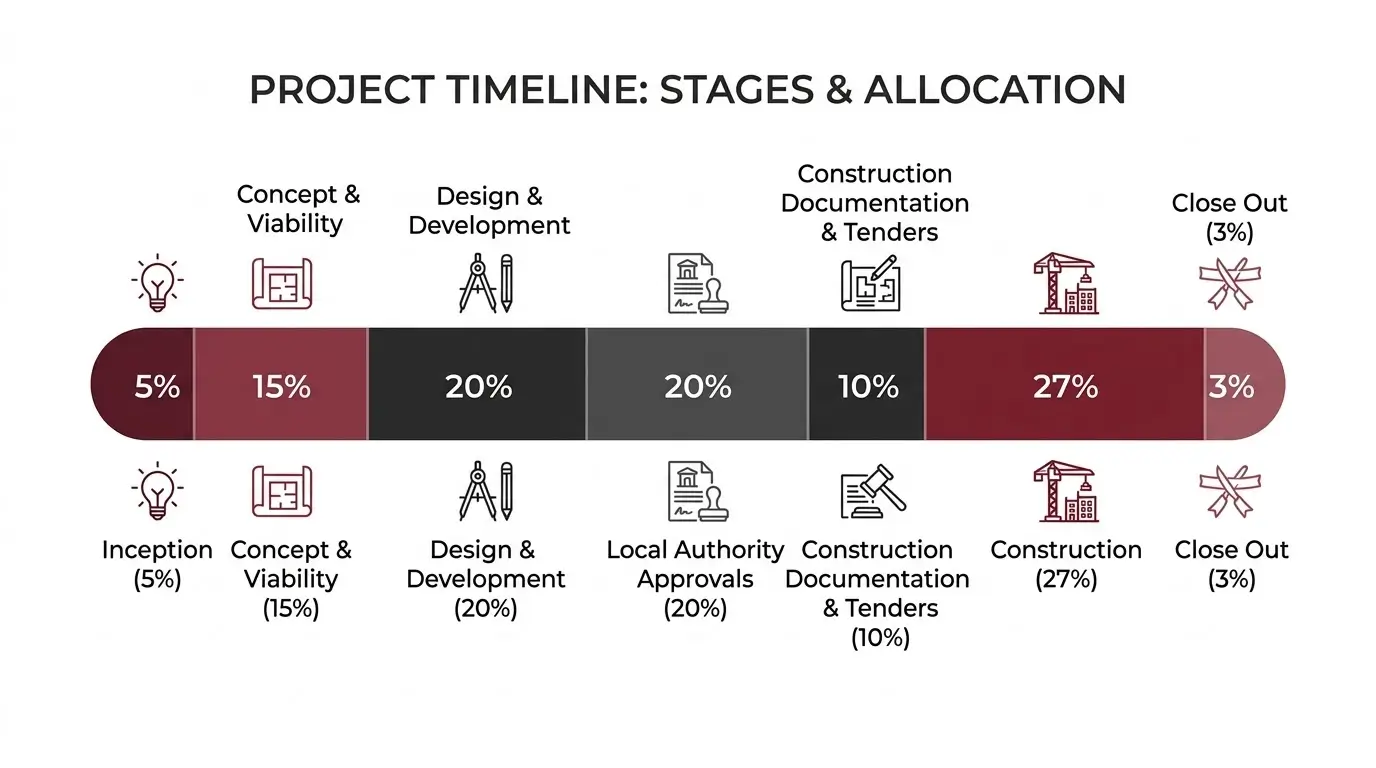
Two things worth noticing here. Construction supervision, being on site while the building actually goes up, takes the largest single share, at 27%. That’s deliberate. A lot of what goes wrong on Kenyan construction sites happens because nobody with design authority is checking the work as it’s built, not because the drawings were wrong to begin with.
The approval stages (local authority submissions plus tender documentation) together account for 30% of the fee. That’s not paperwork for its own sake — a rejected county submission or a poorly evaluated tender can cost you months, and a lot more than the architect’s fee ever would.
What Changes the Price
A few factors move the number up or down beyond the basic percentage:
- Project complexity. A church or hospital involves more consultants, more code compliance, more coordination than a standard office fit-out.
- Site conditions. Difficult terrain, contested land boundaries, or poor access all add time before design even starts.
- How much of the process you actually need. Some clients already have land, financing and a rough brief, and only need design through to tender. Others need the full journey from feasibility study to handover. You shouldn’t pay full-service rates for a partial scope.
- Consultants. Structural engineers, quantity surveyors and M&E consultants are typically separate from the architect’s fee unless the firm coordinates them directly.
If a quote you’ve received doesn’t map onto stages like these, ask why. A fee that’s just one round number for “the whole project” makes it very hard to know what’s included, and very easy for scope to quietly expand without a matching invoice.
Architect-Led vs Contractor-Only: What the Fee Actually Buys You
Some clients skip the architect fee altogether and go straight to a contractor with a rough sketch. It can look like a saving on paper. Here’s what’s actually different between the two routes:
| Factor | With an architect (full process) | Contractor-only |
|---|---|---|
| Design accountability | One qualified professional owns the design from concept through to handover | Design decisions are often made on the spot, on site |
| County / approval risk | Handled as a defined stage of the fee, before construction starts | Often left until it becomes a problem |
| Site supervision | Independent inspection against approved drawings | The contractor is effectively checking their own work |
| Cost visibility | Broken into stages, so you know what each part costs | Usually one lump-sum figure, hard to audit |
None of that means every contractor-only build goes wrong. But it does explain why the fee exists in the first place, and why it’s structured around supervision and approvals rather than just drawings.
A Firm Doing This Since 1994
Trioscape Space Planning Ltd has been structuring projects this way since it was founded in 1994 as Trioscape Architects, later reorganised in 1997 to take on larger institutional work. Over three decades, that stage-by-stage process has been applied to work ranging from the Holy Family Basilica underground parking silo in Nairobi CBD to the 1,800-unit Civil Servants Housing project on Park Road, alongside long-term partnerships with organisations including the Archdiocese of Nairobi and Tangaza University College. Read more about Trioscape’s history and process.
That kind of repeat institutional work only happens when clients can see, invoice by invoice, exactly what they’re paying for and why.
Questions to Ask Before You Agree on a Fee
- Is the fee a percentage of construction cost, or a fixed sum, and what happens if the budget changes?
- Which stages are included, and which (if any) are billed separately?
- Are structural, M&E and other consultants part of this fee or procured separately?
- Does the fee include site supervision through to completion, or does it stop at handover of drawings?
- What happens if county approval is delayed, is that time billed differently?
Getting clear answers to these before signing anything is worth more than negotiating the headline number down.
The Bottom Line
Architect fees in Kenya make more sense once you see them broken into stages rather than as one number. A firm that can show you exactly what inception, design, approvals, tendering and site supervision each cost is a firm that’s easier to hold accountable, and less likely to hand you surprises halfway through a build.
Still Comparing Architect Fees in Kenya?
Tell us about your project and we’ll walk you through how our fee breaks down stage by stage, not just a single number, so you know exactly what you’re paying for.
If you’re planning a project, read more about how Trioscape’s architectural design services work, or browse completed and ongoing projects for a sense of scale and scope.
FAQs
Are architect fees in Kenya regulated?
The Architectural Association of Kenya (AAK) publishes professional guidance on fee structures, and registered architects are expected to work within recognised scales. In practice, most firms quote based on project scope and complexity within that framework.
Is it cheaper to skip an architect and go straight to a contractor?
It can look cheaper upfront, but without a properly supervised design and approval process, you’re more exposed to rework, rejected county submissions and contractor disputes, all of which usually cost more than the architect’s fee would have.
Does the fee include construction supervision?
Not always — some firms only cover design and stop at handover of drawings. At Trioscape, site supervision through to close-out is built into the process, which is why it makes up the largest share of the fee.
How early should I bring in an architect?
As early as possible, ideally before you’ve finalised a budget or bought land, since feasibility and site assessment at the inception stage can prevent costly decisions later.